Our most recent community show featured an introduction to Reltio Ontology Builder, a web-based agentic capability that transforms one of the most time-consuming phases of data modernization — the discovery and design of your data model — into a process that takes minutes instead of months. The session was led by Gaurav Gera, Director of Product Management for Reltio's core platform.
Why Context Is the Foundation of AI
Gaurav opened by grounding the session in a challenge many organizations face: leadership is asking for AI strategies and agents, teams go off to build them, and the results stay as science projects that never reach production. The culprit is almost never the AI model itself — frontier models are capable. The problem is the data feeding them: siloed, fragmented, inconsistent, and missing the relationships and meaning that agents need to reason well.
What sits in the middle of a working AI system is what Reltio calls the system of context — entities, relationships, interactions, and metadata that are not just clean, but connected and governed. When agents have access to that layer, they can act with confidence and trust. Without it, they hallucinate or stall.
The Vocabulary Behind Trusted AI
It helps to understand the distinct layers that make up a system of context, because they each play a different role — and each must be right for the agents above them to work.
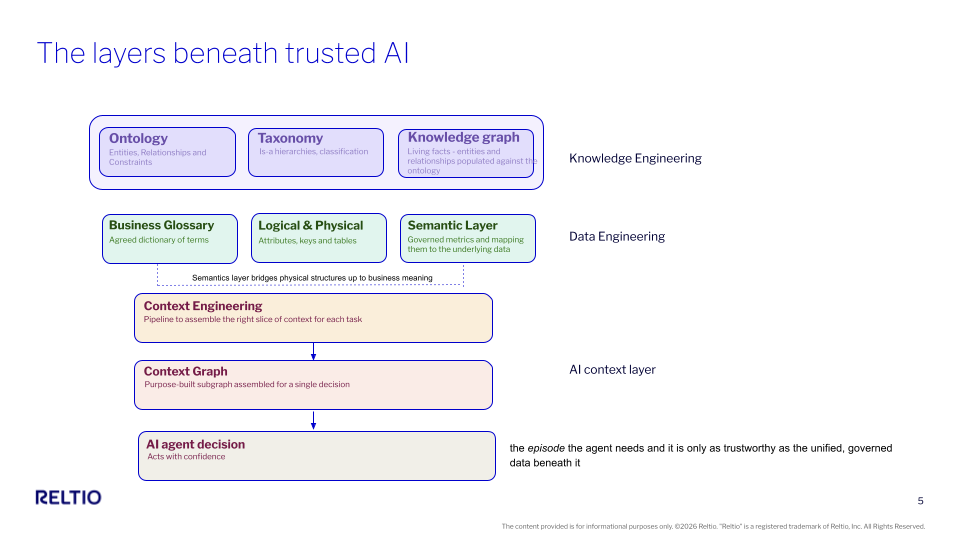
An ontology is the meaning system: the concepts in your business, the relationships between them, and the rules that constrain them. For a financial services firm, this means defining what counts as a Customer versus a Prospect, whether an Account can exist without an owner, and what makes someone a High-Value Customer. This is the layer Reltio formalizes as a canonical data model — entity types, relationship types, and rules that every downstream system and agent shares, rather than each inventing its own definition.
Customer:  A person or organization that holds one or more Accounts
Account:   A financial relationship owned by at least one Customer
Product:   A financial offering an Account can be opened against
Household: A group of related Customers treated as one economic unit

Rules:
 - An Account is owned by at least one Customer
 - A Customer belongs to at most one Household
 - A High-Value Customer is one whose Household assets exceed $1M
A taxonomy organizes things into classification hierarchies. Crucially, the same entity can sit in multiple taxonomies — a financial product appears in a product taxonomy, a regulatory taxonomy, and a sales taxonomy simultaneously. In Reltio terms, this maps to how dynamic survivorship and role-based views surface the same trusted record differently to a compliance officer, a relationship manager, and a marketing analyst.
Product
 └── Deposit Product
     └── Savings Account
         └── High-Yield Savings (SKU FS-4471)
A knowledge graph holds the living facts: actual customers, accounts, households, and the relationships among them, connected according to the ontology. Where the ontology says what can exist, the knowledge graph holds what does. This is the heart of the Reltio Intelligent Data Graph™ — continuously connected, real-time, and queryable in milliseconds.
(Customer: C42)   --OWNS-->          (Account: A9001)
(Account: A9001)  --HELD-AGAINST-->  (Product: FS-4471)
(Customer: C42)   --MEMBER-OF-->     (Household: H7)
(Customer: C42)   --IS-A-->          HighValueCustomer
In an agentic AI context, these layers combine into what is called a context graph: a purpose-built subgraph assembled for a single decision. It doesn't carry the whole enterprise — just enough, drawn from across the stack, for the agent to decide without guessing. For example, to answer "should we proactively offer this customer a wealth-management consultation?", an agent needs to traverse the ontology (what High-Value Customer means), the knowledge graph (this customer's actual accounts and household), the semantic layer (governed metrics like household assets under management), and the governing policies (suitability and consent rules) — all in milliseconds, without a human in the loop. This is the entire premise of context intelligence: bad data in that pipeline becomes high risk at AI speed.
The challenge has always been building this foundation. Turning legacy schemas, spreadsheets, and tribal knowledge into a coherent, AI-ready model is the slowest, most manual phase of any MDM or modernization program — often consuming months before any real implementation begins.
What Is Ontology Builder?
Reltio Ontology Builder is designed to collapse that discovery phase. An AI agent works behind the scenes to analyze your existing source schemas — whether from a legacy application, an existing MDM, or Reltio itself — and translates them into a Reltio-ready canonical model. The output is not just a data model; it's a structured semantic layer with entities, relationships, interactions, and glossary definitions that AI agents can use to reason over real data with confidence.
The tool is available directly at reltio.com — no tenant, no credentials, no cost. Any user can access it today.
A Live Demo: From Legacy Schema to Reltio-Ready Model
Gaurav walked through the tool live. Starting from the existing velocity pack library — which includes pre-built models for B2B, B2C, FinServ, Healthcare, Insurance, and Life Sciences — users can explore entity types, attributes, RDM lookup values, derived attributes, match rules, survivorship rules, and relationship definitions in both list and graphical views. Each attribute comes with a detailed glossary entry: precisely the kind of semantic meaning that allows agents to reason correctly over what data actually represents.
The more powerful demonstration came when Gaurav uploaded a schema file from a legacy application. The agent analyzed the source structure and, within moments, identified the best-fit Reltio velocity pack — in this case B2C at 85% confidence — and produced a full attribute-level mapping showing how each source field maps to the Reltio data structure, with individual confidence scores. Switching to evaluate the FinServ model showed an even stronger match for that particular schema, with organization, individual, and address entities all mapping at 100%.
The entire mapping can be downloaded, giving implementation teams a concrete head start on integration layers and data load pipelines. What would previously have taken months of workshops and manual analysis was done in the span of the demo. Instead of hand-crafting an ontology, a conceptual model, and every mapping between them, a team generates a strong first draft and spends its time reviewing rather than writing.
Who This Is For
Gaurav outlined three groups who benefit most:
Customers already in implementation or modernization projects can use it to preview how their existing data model maps to Reltio before committing to a design, or to compare their current configuration against a Reltio velocity pack to identify gaps. Partners can use it live during customer conversations — loading a prospect's schema on the spot to show, in real time, how their data would look in Reltio, shortening evaluation cycles and replacing lengthy POC timelines with an immediate visual. Data leaders, architects, and stewards evaluating Reltio can use it to understand the depth and specificity of Reltio's pre-built ontologies before any implementation begins.
Q&A Highlights
The session included several questions from attendees. One participant asked whether it was possible to compare two Reltio models against each other — for example, a customer-built product MDM versus Reltio's IDMP-compliant life sciences model. Gaurav confirmed that you can export a JSON schema from your existing Reltio tenant, load it into Ontology Builder, and compare it against any velocity pack, including the life sciences model covering medicinal products, packaged medical devices, and ingredient substances.
Another attendee raised the idea of adding prescriptive suggestions — for instance, flagging when a design choice like using relationships instead of reference attributes might limit capabilities such as household grouping downstream. Gaurav acknowledged this as valuable feedback and committed to taking it to the product team.
What's Next
The recording will be posted to the Reltio Community within the next day or two. If you haven't tried Ontology Builder yet, Gaurav's closing message was direct: go to reltio.com, open Ontology Builder, and try it today. No setup required.
The next community show is scheduled for July 8th, where Snehil Kamal will build an agent live, walking through step by step how to create a custom agent using Reltio AgentFlow Agent Builder.
#CommunityWebinar
#Featured